
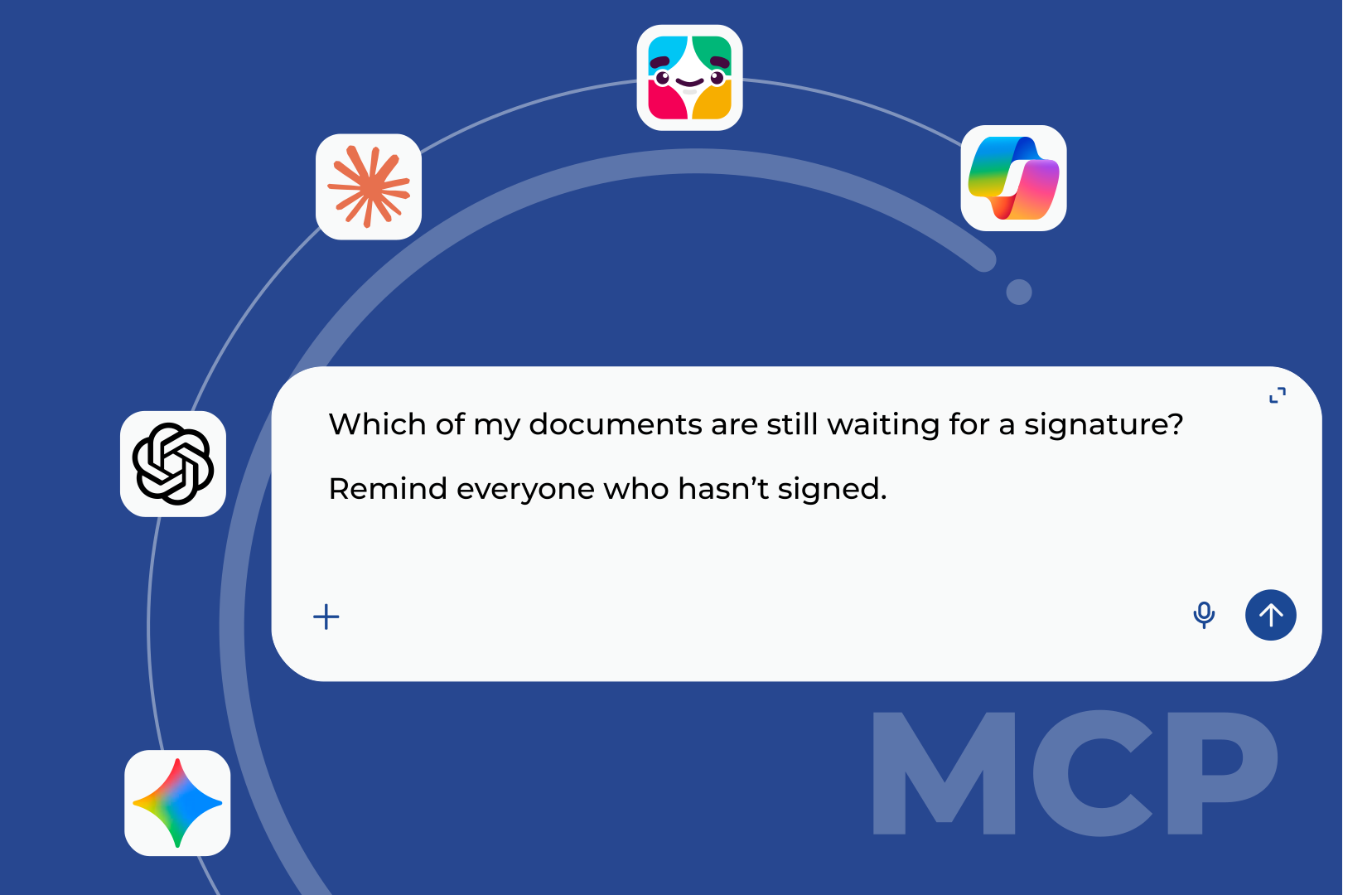
What can you do with Scrive MCP? 7 practical ways to work with agreements
See what you can achieve by connecting Scrive to your AI agent of choice (e.g. Claude, ChatGPT), with our open source MCP server.
Read articleContract templates are often sold as shortcuts. A faster way to get agreements in place, reduce friction, and avoid legal costs. For small and mid-sized businesses in particular, they can feel like an obvious solution.

From a legal perspective, templates are rarely neutral. Every template carries assumptions about jurisdiction, risk, enforceability, and even whether a document can be signed electronically at all. That tension between convenience and responsibility is the reason Scrive has historically been cautious about offering templates, despite clear customer demand.
According to Peter Carlstedt, Chief Legal Counsel at Scrive, the challenge has never been whether templates are useful. It has been about where legal responsibility begins and ends.
Scrive was created as a signing solution, not a legal drafting service. The original idea was straightforward: customers bring their own documents, however they are produced, and Scrive ensures they can be signed securely, compliantly, and with strong evidentiary value.
That distinction is important. Some companies that offer templates also provide legal advisory services. They draft documents, maintain them, interpret them, and answer questions about how they should be used. Scrive has deliberately stayed out of that space.
Once a company publishes templates, questions inevitably follow. Is this valid in another jurisdiction? Can this clause be interpreted a certain way? Does this comply with local employment or consumer law?
From a legal standpoint, that quickly introduces risk, administration, and expectations that Scrive does not want to create. Enabling legally binding signatures is one thing. Advising on the legal content of an agreement is another.

Despite those concerns, customer behaviour is clear. Many organisations, especially smaller businesses without an internal legal function, need a practical starting point. They want something that works for common scenarios such as NDAs, basic employment agreements, or straightforward supplier contracts.
The alternative is often worse. Downloading a random template found online offers no clarity around jurisdiction, legal alignment, or suitability. Compared to that, a vetted template designed for a specific legal context provides a meaningful baseline of assurance.
This is where Scrive’s position has evolved. Not because templates suddenly became risk-free, but because they can add real value when they are tightly scoped and responsibly produced.
Every template is a compromise. The more flexible and comprehensive it becomes, the harder it is to use correctly. The simpler it is, the narrower its scope must be.
Scrive’s templates are intentionally designed for common, repeatable use cases, with a low requirement for customisation outside the typical editable parameters. If a template requires extensive customisation, alternative clauses, or legal judgement calls, it stops being a helpful tool and starts becoming a liability.
This is also why some agreements are excluded altogether. Highly specialised contracts, or those that depend heavily on individual circumstances, lose their value once they are made generic.

One of the most common misconceptions about templates is how transferable they are across borders. Even within the EU, legal implementation varies significantly between countries.
A template drafted for Swedish law may not be suitable in Germany or Denmark. Employment agreements, consumer contracts, and regulated industry documents are particularly sensitive to local rules. Even the ability to use an electronic signature for certain agreements can differ by jurisdiction.
For that reason, Scrive’s templates are jurisdiction-specific. They are vetted by external law firms and clearly positioned for defined markets and purposes. Expanding templates to new countries requires the same level of local legal validation. Anything less would undermine trust.
Providing templates does not mean assuming responsibility for how they are interpreted or enforced. That responsibility always rests with the signing parties.
What Scrive does stand behind is the integrity of the signing process itself. This includes the evidentiary package around an electronic signature: proof of identity, intent, and that the signing process itself is in accordance with applicable regulations.
The content of the agreement is a separate matter. Whether a clause holds up in court depends on how it is used, not on the platform used to sign it. This distinction is reflected in Scrive’s disclaimers and guidance.

There are signs of increased standardisation, particularly at the infrastructure level. Initiatives such as the EU Digital Identity Wallet are driving the need for harmonised formats for elements like powers of attorney, which may influence how certain contractual components are structured.
That does not mean contracts themselves will become universally interchangeable. While principles like offer and acceptance are broadly consistent, local consumer protection laws, employment rules, and regulatory requirements will continue to shape how agreements must be drafted and used.
Standardisation may reduce friction, but it will not remove the need for jurisdiction-aware templates.
Templates are tools, not guarantees.
Used well, they save time, reduce barriers, and help businesses focus on what matters most. Used carelessly, they create a false sense of security.
The critical question is not where a template comes from, but whether it is understood, appropriate for the situation, and aligned with the legal context in which it is used. Convenience should never replace comprehension.
Scrive’s goal is not to offer a template for every scenario, but to help businesses get started responsibly, with clear boundaries around risk, jurisdiction, and accountability.
See what you can achieve by connecting Scrive to your AI agent of choice (e.g. Claude, ChatGPT), with our open source MCP server.
Read article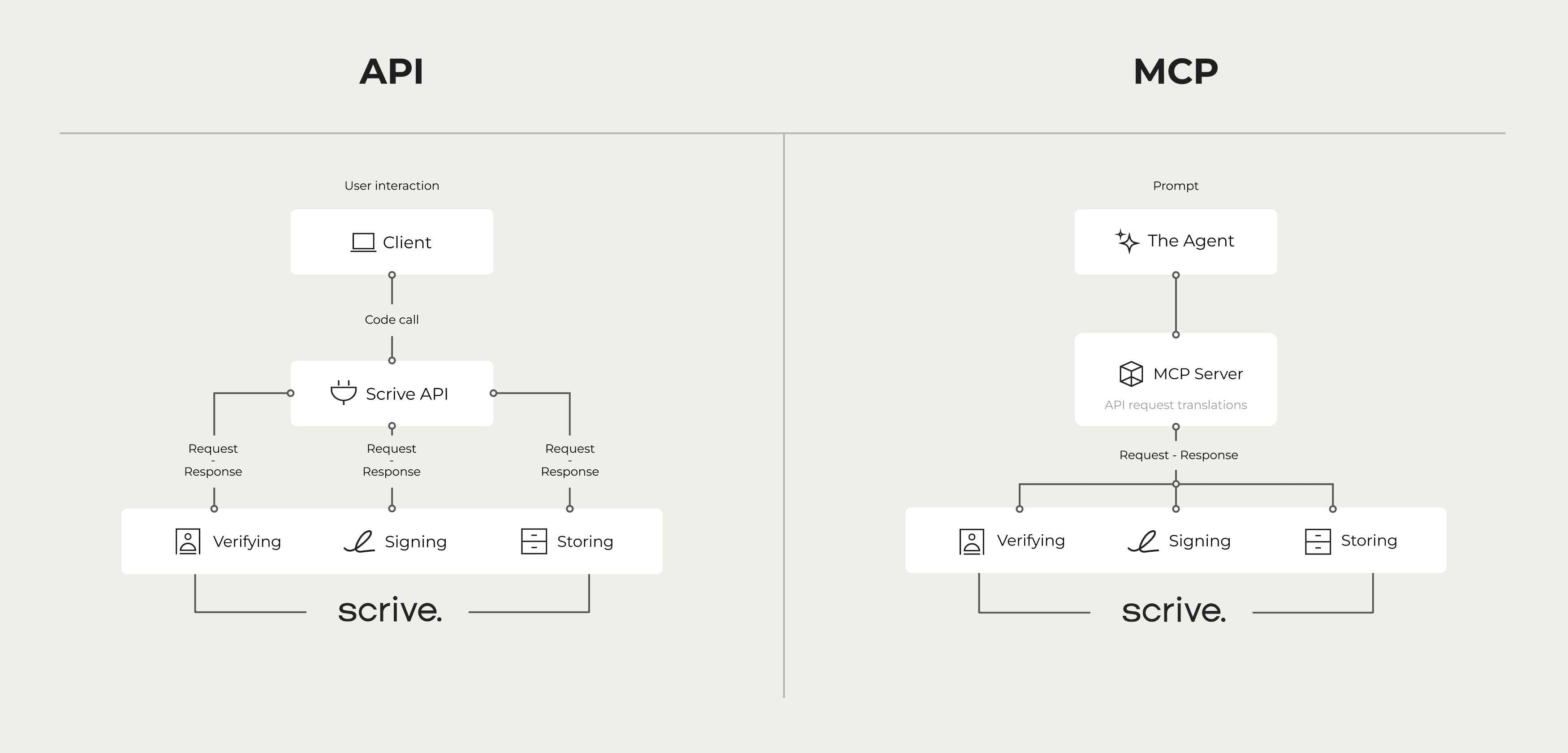
APIs connect software to software. MCP connects AI agents to software. Learn the difference and how Scrive's MCP server brings trusted eSigning to AI.
Read article
A side-by-side comparison of Scrive and DocuSign, using published G2 satisfaction scores. Sources and dates linked.
Read article