
Book a demo
Book a meeting with us to see how Scrive can help streamline your processes and create value for your organisation.
Boka demo
Quick facts about the template
Format: Word (.docx)
Cost: Free
Contract type: Fixed-term consulting agreement
Suitable for: Companies hiring consultants + consultants seeking clear terms
Last updated: May 2026
Created/reviewed by: Bird & Bird Advokat KB
A consultancy agreement is a contract between a client (the commissioning party) and a consultant. It sets out the scope of the engagement, responsibilities, deliverables, and compensation, as well as how the parties will work together. Its purpose is to create clarity around expectations and protect both the business and the consultant throughout the assignment.
Consultancy agreements are used in many sectors, from IT development and marketing to project management. They also cover interim roles and strategic advisory services.
With Scrive, you can easily create, share, and sign consultancy agreements electronically, legally binding under the EU eIDAS regulation, with secure identity verification via methods such as BankID or other eID solutions.
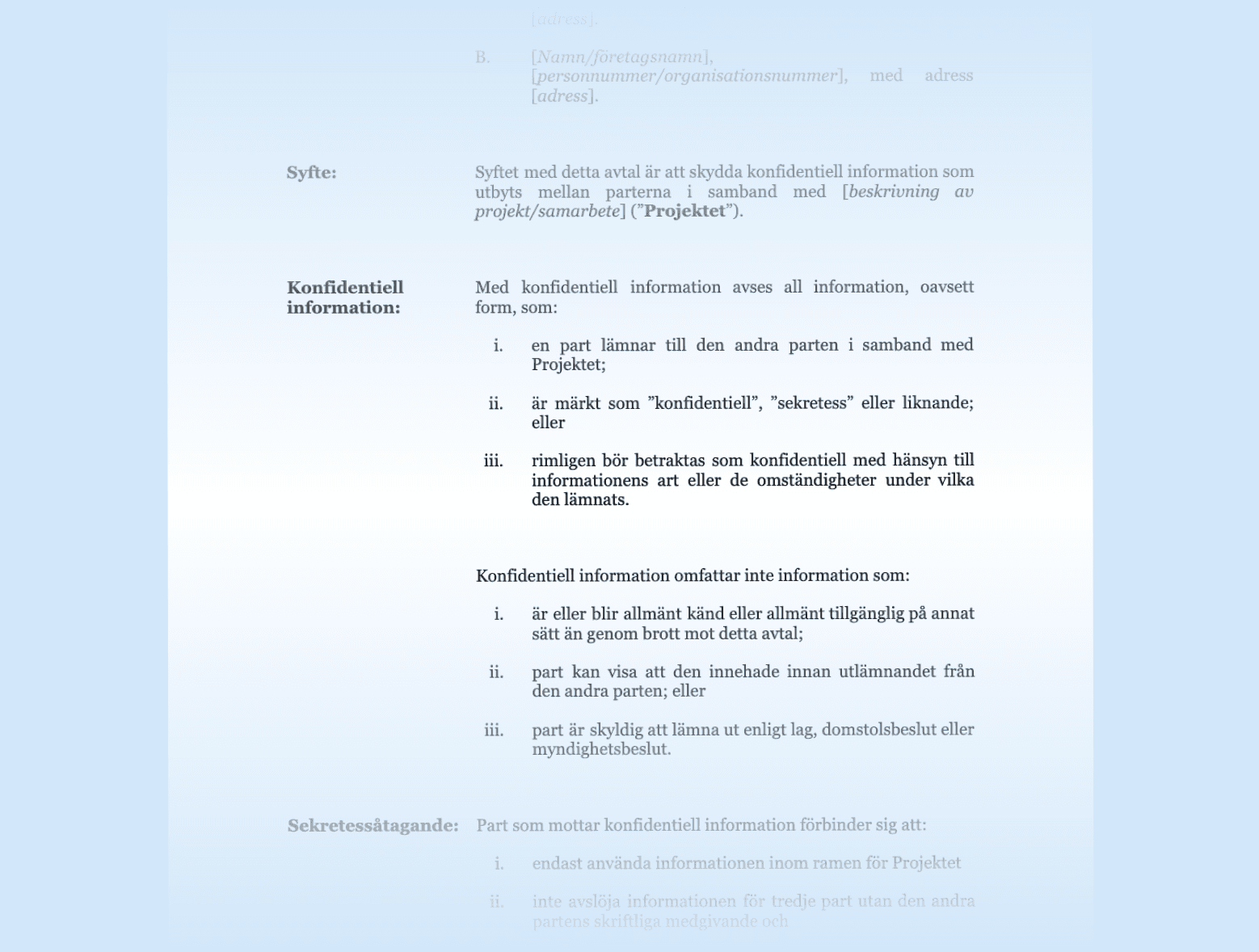
A consultancy agreement is needed in most situations where an external specialist is engaged to carry out an assignment.
Common examples include:
A well-drafted consultancy agreement prevents misunderstandings and ensures a professional, legally sound working relationship from day one.
Different terms might apply depending on the nature of the engagement. Here are the most common agreements:
Fixed-term consultancy agreement
Used for projects with clearly defined start and end dates. The agreement ends automatically when the project is complete or the term expires.
Rolling (open-ended) consultancy agreement
The agreement continues indefinitely until either party gives notice to terminate. Suitable for ongoing or recurring consulting relationships.
Project-based consultancy agreement
Structured around a specific project, with defined deliverables and milestones. Payment is typically tied to outcomes or project phases.
Framework agreement with call-off orders
Used when a business engages the same consultant across multiple assignments over time. A master agreement governs the relationship, with individual call-off orders for each new engagement.
Please note that the template we provide is designed for fixed-term consultancy agreements.
A professional consultancy agreement should always contain the following:
A clearly written agreement gives both parties confidence and reduces the risk of disputes throughout the engagement.

The most common approach is to engage a law firm to draft the agreement though this can be costly for simpler assignments. Therefore, Scrive offers a free Word template that is straightforward to customise for most standard consulting engagements. When signed digitally, the agreement is stored securely in Scrive’s e-archive and can be exported to external systems such as SharePoint, Google Drive, or CRM platforms.
With Scrive you get:
Download the free consulting agreement template
Please also read our guide on how to sign PDFs with Scrive
A consulting agreement is crucial for creating a clear and secure working relationship between consultant and client. By regulating the scope of work, compensation, confidentiality and intellectual property rights, the risk of conflicts and misunderstandings is reduced.
With Scrive you can digitalise the entire process – from creation to signing – and get legally binding agreements with full traceability.
Please note that these documents are templates only and cannot replace tailored legal advice for your specific situation. When using these documents, ensure that the instructions are read carefully and that any uncertainties or questions are discussed with a qualified lawyer in the relevant field. Neither Bird & Bird nor Scrive AB can be held liable for the content of the documents or any consequences arising from their use.
This is recommended to avoid ambiguities regarding liability and compensation.
This should be regulated in the contract. Ownership is often transferred to the client.
The most common arrangements are: hourly rate, fixed project fee, or a recurring retainer. The payment structure should be clearly stated in the agreement, along with invoicing intervals, payment terms, and any late-payment penalties.
A consultancy agreement governs an independent contractor or freelance relationship. The consultant is self-employed, invoices for their services, and is responsible for their own taxes and insurance. An employment contract creates an employer-employee relationship, which carries different legal obligations and protections. Misclassifying an employee as a consultant can have serious legal and tax consequences — if in doubt, seek legal advice.
Yes. A template will get you far, but for complex assignments it may be wise to consult a lawyer.
Book a meeting with us to see how Scrive can help streamline your processes and create value for your organisation.
Boka demoWe offer ready-made contract templates that save time, reduce risk, and improve quality. Our templates cover most industries. Browse our selection below to find the right contract template and download it instantly.
See all agreement templates