
1. Learn – establish foundational understanding
Give everyone a clear view of what AI is, how it works and how it affects their day-to-day responsibilities.
Posted by Johanna Santos
Artificial intelligence is rapidly reshaping how organisations operate, and HR sits at the centre of this shift. Yet many HR teams are attempting to move straight into AI experimentation without first establishing the digital foundations needed to support it.
According to Stina de Hevesy, Chief Human Resources Officer at Scrive, this imbalance can become an obstacle to meaningful progress in the HR space.
“AI is incredibly powerful, but it cannot compensate for analogue foundations,” Stina de Hevesy explains. “If HR processes are still paper-heavy or manually managed, introducing AI won’t accelerate progress – it will simply magnify what isn’t working. Digital maturity isn’t optional in HR; it’s the groundwork that makes any responsible use of AI possible.”
The path to successful AI adoption in HR doesn’t just start with experimentation, it also starts with building strong digital workflows and ensuring the organisation is ready to use AI effectively.
As skills change quickly and traditional job roles grow more fluid, HR now plays a decisive role in preparing organisations for AI. Employees look to HR for guidance, clarity and confidence, and organisations rely on HR to steer both capability-building and change.
“People do not resist AI because they dislike technology,” Stina de Hevesy says. “They resist it because they don’t understand how it affects their work, what skills they will need, or how to make use of the opportunities. HR’s role is to bridge that gap, to turn uncertainty into readiness through learning, structure and clear communication.”
This expanded mandate positions HR as a central partner in the organisation’s transformation, not simply a support function.
A fundamental shift now underway is the move from rigid job titles to a skills-based approach, where employees are matched to business needs based on what they can do rather than the role they happen to hold. AI technologies amplify the benefits of this model, using skills data to match people to projects, tasks and opportunities at speed.
“Organisations that understand their skills landscape are able to adapt far more quickly,” Stina de Hevesy believes. “When we free people from rigid job definitions, we enable them to use their strengths where they matter most. AI is at its best in organisations that are already agile, and agility comes from recognising and activating skills rather than protecting static roles.”
This mindset requires accurate and continuously evolving skills data, something HR must curate and maintain.
While AI enthusiasm is high, many organisations still rely on manual, paper-heavy HR workflows. Printed agreements, email-based onboarding, scattered documentation and inconsistent processes make it difficult to create the strong, clean data layer that AI relies on. The same challenges apply to the many forms that flow through HR, such as parental leave requests, absence forms, new-employee registration, certificates and other documentation, which often remain fragmented, paper-based or handled through ad-hoc tools.
“We still see organisations piloting AI tools while sending employees home with paper contracts to sign,” Stina de Hevesy notes. “It’s an admirable ambition, but the sequence is wrong. Digital signatures, identity verification and automated workflows are not administrative upgrades; they are the infrastructure that allows AI to operate safely, ethically and effectively.”
Without these foundations, AI adoption risks becoming fragmented, risky and, ultimately, ineffective.
Scrive’s mission aligns directly with the foundations required for responsible AI adoption in HR. By helping organisations replace analogue processes with secure digital workflows, such as e-signatures, identity verification, forms and automated contract management, Scrive creates the clean, reliable data layer that AI depends on.
Once digital workflows are in place and principles for AI use are defined, organisations can scale automation and unlock high-quality AI use cases with confidence. Scrive enables this by providing the secure, structured infrastructure that makes responsible, effective AI adoption possible.
Give everyone a clear view of what AI is, how it works and how it affects their day-to-day responsibilities.
Enable teams to test AI tools in real contexts, identify opportunities and replace fear with familiarity.
Support advanced learning for specialists through courses, peer sessions and expert guidance.
AI is not a shortcut to modernisation. It is an accelerator for organisations that have already invested in digital workflows, skills development and cultural readiness. Those that take the time to build these foundations will unlock AI’s real value and move forward with confidence.
“AI transformation is never the responsibility of one function,” Stina de Hevesy adds. “Business identifies the opportunity, IT builds the solution, and HR prepares the people. When those three elements move together, AI becomes a natural extension of how the organisation works.”
Stina de Hevesy concludes; “The organisations that succeed with AI are not the fastest adopters, they are the ones that prepare intentionally. Digitalise your processes. Build trust in your data. Empower your people. Once those elements are in place, AI becomes transformative rather than disruptive.”
Scrive is proud to support organisations along this journey, helping them establish secure, reliable digital foundations that make the transition to AI possible and powerful.

Skills shortages, rising costs and growing obligations are putting increasing pressure on housing companies and cooperatives. One often-overlooked opportunity to create capacity lies in their own contract processes.
Read article
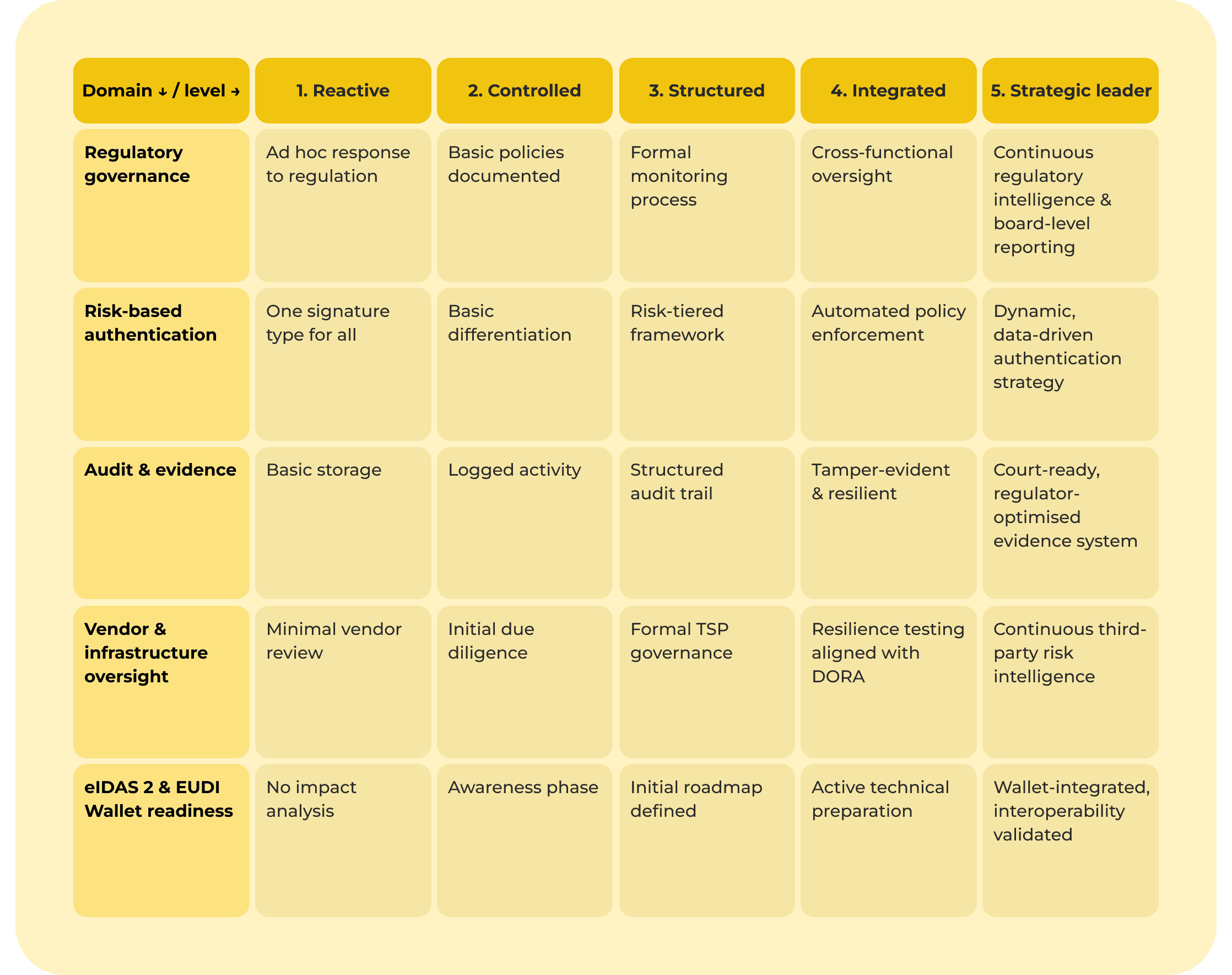
For organisations operating in Europe, the ability to assess and advance digital compliance maturity is now the foundation.
Read article